How to choose the "right" disposable salad bowl? Xinyatai, with 20 years of experience, offers the answer.
 123123123
Driven by both healthy eating and the takeout economy, salads have become the "traffic driver" in the light food sector. However, for the operators and consumers of salads, choosing a single-use salad bowl is far more than just "selecting a container" - it involves costs, experience, brand image, and environmental responsibility. So, how should one make the right decisions among capacity, materials, and safety? As a leading player in the food packaging industry with over 20 years of experience, Xinyaitai, by offering a full range of products, cutting-edge eco-friendly materials, and top-notch manufacturing capabilities, has provided a standardized and professional solution to this problem.
1. How to choose the capacity? Xinyatai "tailors solutions" to meet all scenarios' needs
The choice of salad bowl capacity directly affects both the satisfaction of consumers during their meal and the cost control of the merchants. From 500ml to 1500ml, different capacities correspond to completely different consumption scenarios. However, the common sizes available on the market sometimes cannot precisely meet the brand's requirements. This is precisely why "customization" has become a key competitive advantage.
Wuhan Xinyatai is a national high-tech enterprise that integrates design, research and development, production and sales. It not only offers standard sizes of salad bowls but also supports full-scale customization from specifications to appearance. From mini bowls for children's meals to large-capacity bowls for family sharing, from takeout packaging bowls to exquisite dining boxes, Xinyatai can help enterprises find the best balance between capacity and cost based on different dish types, average order value and brand characteristics.

2. How to Select Materials? Xinyatai's "Four Major Material Matrix" Ensures Optimal Solution
The materials of the disposable salad bowls directly determine their safety, environmental friendliness, heat resistance and cost. Currently, the four most mainstream materials on the market - PP plastic, pulp/cane residue molded bowls and PLA polylactic acid - each have their own advantages and disadvantages. Xinyaitai has achieved a comprehensive coverage of these four materials in its product layout, becoming one of the few enterprises in the industry that can provide one-stop solutions for various salad bowls made of multiple materials.
-
PP plastic - an excellent choice for cost-effectiveness, suitable for long-distance food delivery
PP plastic has a wide temperature tolerance range (-20℃ to 120℃), can be heated in a microwave oven, and has good shock resistance and sealing performance. Xinyatai's PP salad bowls are made from high-quality food-grade PP materials, and are particularly suitable for scenarios such as reheating salad or pasta mixed bowls.
-
Paper pulp/cane residue molded bowls - Environmental pioneers, naturally biodegradable
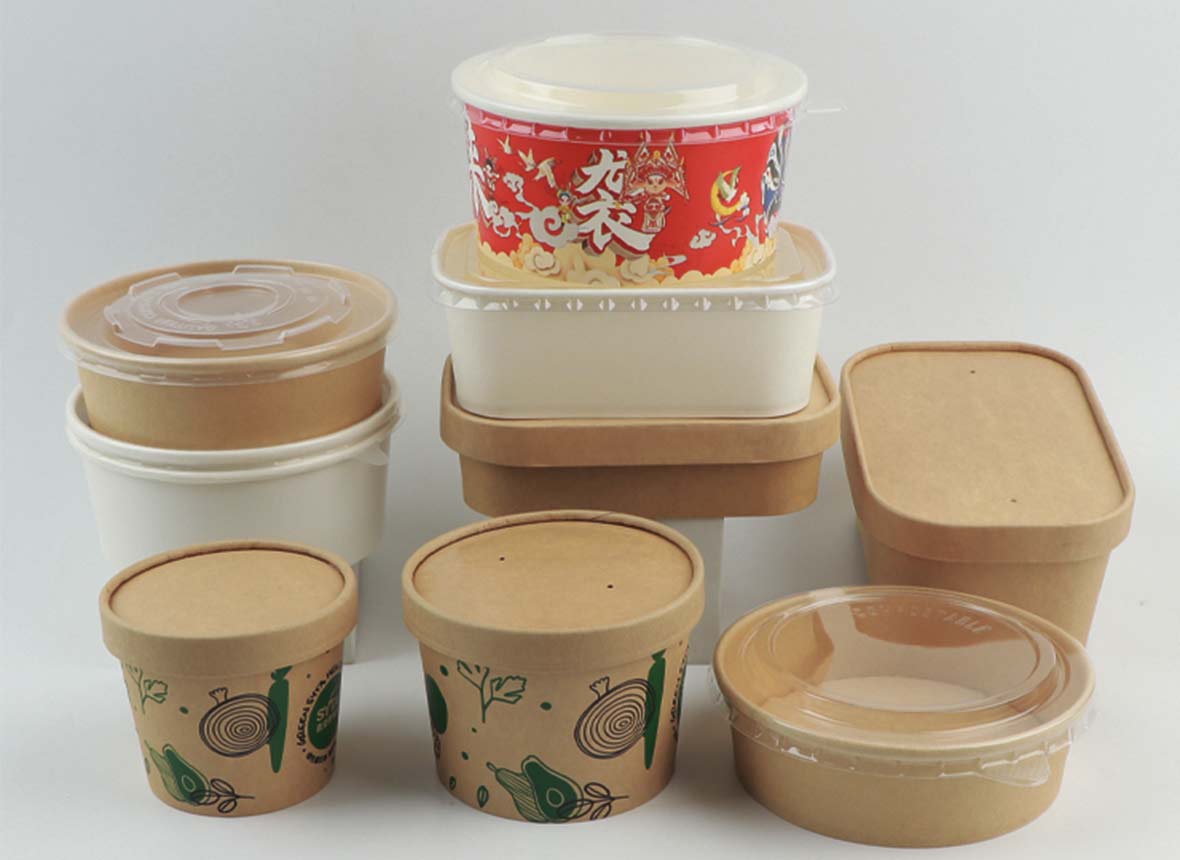
The paperboard and pulp molded tableware made from sugarcane residue has low raw material costs and is environmentally friendly. The medium and long fibers give it excellent strength and toughness. After use, it can naturally degrade under specific conditions. Xinyaitai has achieved full-process coverage from raw materials to finished products in the field of fully biodegradable food packaging containers. The eco-friendly paper bowls are one of its core flagship products.
-
PLA (Polylactic Acid) - A high-end biobased material that combines excellent appearance with environmental friendliness.
PLA is made from plant raw materials such as corn starch, featuring a low carbon footprint and a clear and transparent visual texture. The products of Xinyatai Food Packaging Container Division mainly consist of PLA and water-based coatings. They are recognized by the industry as the most promising new "eco-material" and are the ideal containers for high-end light food brands to enhance the value perception of their products.
The products under Xinyatai cover a wide range of food packaging containers including 100% biodegradable paper cups, paper bowls, paper bags, tableware and containers, aviation tableware, soup bowls, knives, forks, spoons, cup and lid covers, and straws. They are not only sold in countries and regions around the world such as Europe, America, Australia, the Middle East, and South Africa, but are also widely used in various terminal scenarios including large chain supermarkets, hotels, restaurants, coffee and tea drinking establishments, etc.

3.Compliance and User Experience: Xinyatai’s “Three Lines of Defense”
When selecting salad bowls, safety and compliance serve as the absolute baseline. Xinyatai has established a rigorous, three-tiered system of safeguards to ensure product safety and quality control:
The First Line of Defense: A Rigorous, Food-Grade Production Environment. Xinyatai has constructed dust-free workshops engineered to meet stringent food-grade standards. Our production environment adheres to the benchmarks of a Class 10,000 sterile cleanroom, thereby safeguarding the food safety of every single salad bowl we produce.
The Second Line of Defense: A Comprehensive International Certification System. Xinyatai has successfully obtained numerous internationally recognized certifications—including ISO 9001, ISO 14001, ISO 45001, and BSCI—enabling us to implement sophisticated, end-to-end management across our entire value chain, from raw material procurement and manufacturing to the final release of finished products

The third Line is a sustained commitment to technological innovation. Xinyatai has consistently dedicated itself to overcoming technical barriers associated with eco-friendly materials—such as water-based coatings—and once conducted a rigorous 12-week comparative study to validate the environmental credentials of its water-based coating products. In recent years, the company’s cumulative investment in intelligent production lines and digital management platforms has exceeded 50 million RMB, driving an increase in production volume from 1 billion units to nearly 5 billion units.
4.Future Trends: From "Single Use" to "Lifelong Stewardship"
As plastic restriction policies continue to tighten across the EU and various regions within China, molded plant fiber and water-based coated paper packaging are pioneering a new direction for the industry. Keeping its finger firmly on the pulse of the times, Xinyatai—leveraging its forward-looking R&D strategy and integrated green food packaging solutions—is empowering businesses to remain at the very forefront of the eco-friendly movement. Currently, Xinyatai’s products enjoy robust sales in over 100 countries and regions worldwide—including the United States, Germany, France, Italy, and Spain—and the company has established collaborative partnerships with renowned domestic and international brands such as Huaweifang, Maixiangyuan, Caimingwei, TODAY, China Southern Airlines, and Disney.
In Xinyatai’s view, a disposable salad bowl is not merely a consumable item to be discarded after a single use; rather, it serves as a vital vehicle for conveying brand philosophy and demonstrating corporate social responsibility. From humble beginnings in a workshop spanning less than 500 square meters to now presiding over a modern industrial park covering 120 mu (approx. 8 hectares), Xinyatai has dedicated two decades of unwavering commitment to providing the definitive answer regarding the choice of disposable salad bowls: the best container is, and always will be, the one that is safe, eco-friendly, and sustainable.
To choose Xinyatai is to choose a long-term partner—one that understands packaging deeply, and understands the future even better.