


123123123
 123123123
This guide is written for the people who actually sign the purchase order: gelato and frozen yogurt operators, dessert chains rolling out a seasonal menu, wedding and event caterers, and importers building a paper dessert cups range for their own market.
Every section maps to a decision you have to make before production starts — board and coating, capacity, lid interface, carton cube, print setup — with the specification language to put in an email rather than the vague "good quality, 8 oz" that gets you a reprint.
Freezer storage note: paper ice cream cups are designed for cold and frozen service. They are not a substitute for a double-wall soup cup if you plan to run hot fudge or gravy through the same SKU.
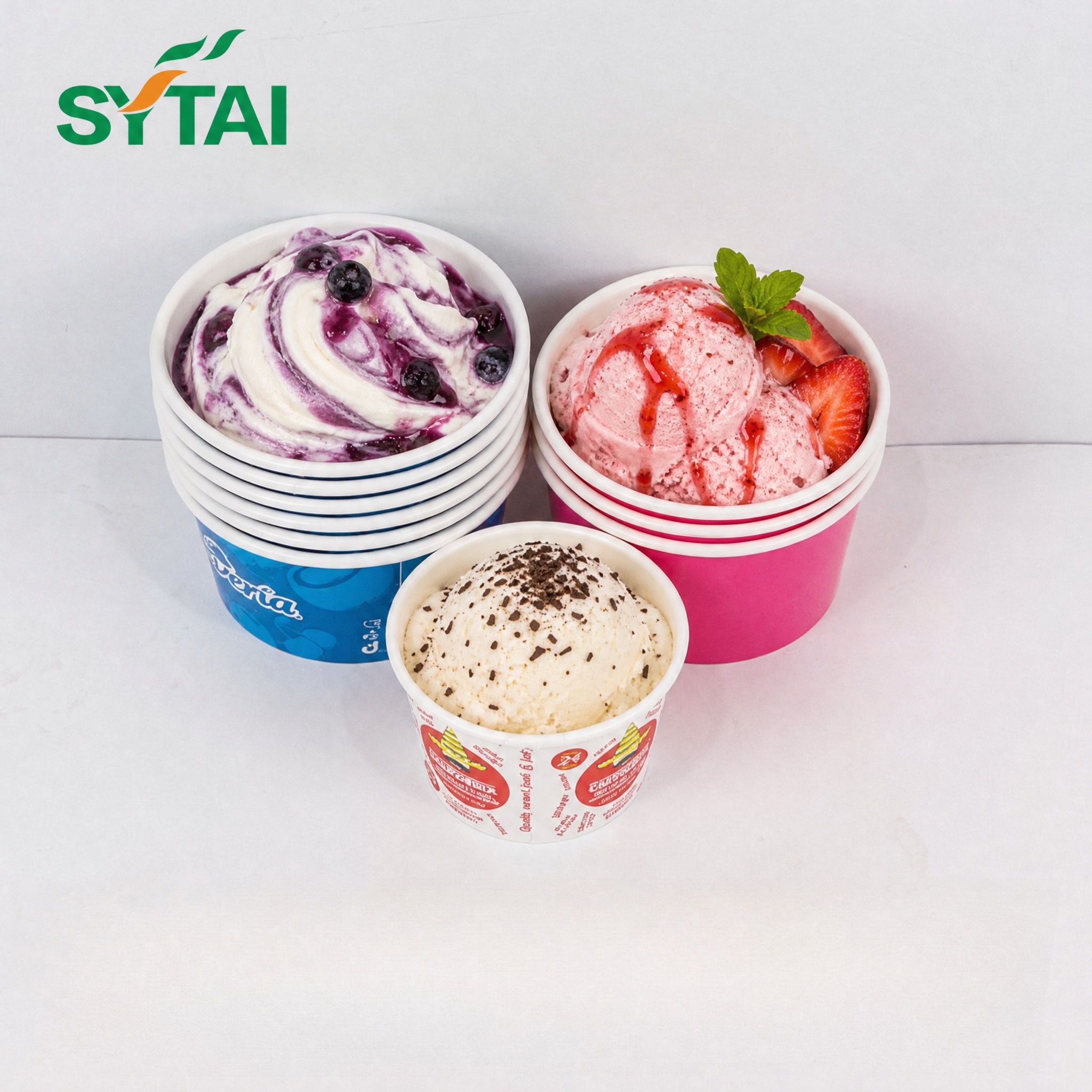
First, at 1,000 pcs per carton for the 4–16 oz range, the cube difference between 4 oz and 16 oz is nearly threefold — so a menu that "just adds a large size" quietly adds freight.
Second, every additional capacity is a separate 30,000-piece minimum order and, in most cases, a separate lid diameter.
Chains that standardise on two capacities and one lid family consistently land better landed-cost numbers than chains running five sizes to satisfy one seasonal promotion.
Same piece count, roughly 45% less ocean freight — which is why "we'll just order the small size" is sometimes the cheapest decision on the sheet, and sometimes the most expensive one if the small cup undersells the menu.

The production of paper ice cream cups involves three distinct processes: coating, printing, and forming. Outsourcing any of these stages often leads to quality drift. At Sytai, we handle all three in-house at our Wuhan facility—featuring proprietary extrusion coating, up to 7-color printing, and forming within a dust-free cleanroom environment. This ensures that product specifications remain consistent across repeat orders, eliminating the need to renegotiate terms every season. We can also provide FDA test reports and FSC Chain of Custody documentation tailored to your target market’s requirements.
Simply share your menu, target landed costs, and the compliance requirements for your destination market with us, and a Sytai account manager will develop a solution that meets your needs.
Paper Ice Cream Cups: Sizes, Lids & Wholesale B2B Guide
2026-11-13
123123123
Paper Ice Cream Cups: A Spec-Level Buying Guide for Gelato Shops, Dessert Chains and Distributors
Most paper ice cream cups are bought on unit price and judged on performance — and those two numbers rarely agree. A 4 oz cup that wicks at the base seam during a 25-minute delivery costs far more than the fraction of a cent it saved on the invoice, because the customer remembers the stain on the bag, not the carton price.
This guide is written for the people who actually sign the purchase order: gelato and frozen yogurt operators, dessert chains rolling out a seasonal menu, wedding and event caterers, and importers building a paper dessert cups range for their own market.
Every section maps to a decision you have to make before production starts — board and coating, capacity, lid interface, carton cube, print setup — with the specification language to put in an email rather than the vague "good quality, 8 oz" that gets you a reprint.
Paper Ice Cream Cups With Lids: The Four Specs That Decide Performance
Four specifications separate a cup that survives the cold chain from one that fails on the counter. They are worth writing into the PO line by line, because "food grade paper cup" describes a category, not a product.
| Specification | What to write in the inquiry | What fails without it |
|---|---|---|
| Board grade and gsm | Virgin food-grade board; gsm quoted per size and per format | Thin board softens under sauce within half an hour, and walls bulge when cartons are stacked in a warm stockroom |
| Interior coating | Single-sided PE, double-sided PE, PLA, or water-based, with coat weight stated | Base-seam wicking, dark saturated patches on the inner wall, a base that gives way under a spoon |
| Rolled rim | Rim ply count and curl tightness, tested at freezer temperature | Hairline cracks at −18 °C that only open after a week in transit, turning a full pallet into scrap |
| Lid interface | Rim outside diameter in mm, with tolerance — not "fits 8 oz" | Lids that will not seat one-handed at peak, or that lift under dome pressure and leak on the way to the customer |
The practical test is not a lab report, it is a service simulation. Fill the cup with the wettest thing on your menu — strawberry sauce, caramel, chocolate chips and melting ice cream — and leave it for 30 minutes. A double-layer PE interior is what keeps the inner wall from showing dark saturated spots and the base from softening inside that window; single-sided PE is usually enough for dine-in service where the cup is finished in ten minutes.
Freezer storage note: paper ice cream cups are designed for cold and frozen service. They are not a substitute for a double-wall soup cup if you plan to run hot fudge or gravy through the same SKU.
4 oz vs 8 oz Paper Ice Cream Cups: Matching Scoop Count to Carton Cost
The most-searched capacity terms in this category are the small ones — 4 oz paper ice cream cups with lids and 8 oz paper ice cream cups — and that is not an accident. Those two sizes carry most menus, most party orders and most retail multipacks.
| Format | Top × bottom × height (mm) | Pcs per carton | Carton size (cm) | CBM per 1,000 pcs | Typical serve |
|---|---|---|---|---|---|
| 2 oz | 61.5 × 51.65 × 30 | 2,000 | 50.5 × 31.5 × 25 | 0.0199 | Tasting spoon, sample station |
| 4 oz | 75 × 60 × 48 | 1,000 | 38 × 30.5 × 36 | 0.0417 | Single scoop, kids' size |
| 6 oz | 95 × 80 × 53 | 1,000 | 49 × 39.5 × 37 | 0.0716 | Single scoop with one topping |
| 8 oz | 95 × 73 × 62 | 1,000 | 48.5 × 39.5 × 39.5 | 0.0757 | Two scoops, standard menu cup |
| 12 oz | 101 × 80 × 78 | 1,000 | 52.5 × 42 × 42.5 | 0.0937 | Three-scoop sundae |
| 16 oz | 110 × 90 × 85 | 1,000 | 56 × 46 × 42.8 | 0.1103 | Large sundae, gelato shake |
| 20 oz | 126 × 103 × 76 | 600 | 52 × 39.5 × 42.8 | 0.1465 | Share format, delivery, family pack |
Two things in that table carry more weight than the dimensions.
First, at 1,000 pcs per carton for the 4–16 oz range, the cube difference between 4 oz and 16 oz is nearly threefold — so a menu that "just adds a large size" quietly adds freight.
Second, every additional capacity is a separate 30,000-piece minimum order and, in most cases, a separate lid diameter.
Chains that standardise on two capacities and one lid family consistently land better landed-cost numbers than chains running five sizes to satisfy one seasonal promotion.
Biodegradable Paper Ice Cream Cups: PE, PLA or Water-Based Coating?
| Coating | Water resistance | Cold-chain performance | End of life | Best fit |
|---|---|---|---|---|
| Single-sided PE | Good — standard moisture barrier | Good | Paper stream; coating separation required at the mill | Dine-in, short takeaway, cost-driven programs |
| Double-sided PE | Strong — reliable against seepage | Excellent | Paper stream | Saucy sundaes, longer delivery radius |
| PLA lining | Good — paper-like hand feel | Good, but humidity-sensitive in storage | Industrially compostable where collection exists | Premium brands built on a sustainability claim |
| Water-based coating | Good — oil resistant | Good | Smoother paper recycling, no plastic layer | Chains with explicit plastic-reduction targets |
1、Compostable is a certified claim, not a description. PLA-lined cups are tested to EN 13432 in Europe or ASTM D6400 in the US, and both standards describe industrial composting.
A PLA cup in a home compost bin or a landfill is not "breaking down in weeks", and saying so in your own marketing is a compliance risk in several markets. If you are sourcing compostable ice cream cups for a certified program, the certificate is the deliverable — not the word printed on the carton.
2、Water-based coating is a recycling story, not a composting story. It removes the polyethylene layer, which makes the cup easier to pulp — but unless the finished cup carries a compostability certificate, do not market it as compostable.
3、Storage matters. PLA is hygroscopic. Cartons stored in a humid back room, or a container that sat on a dock through a rainstorm, can soften before the cup ever meets ice cream.
Paper Ice Cream Cups Wholesale: MOQ, Carton Cube and Landed Cost
Most wholesale ice cream cups are quoted FOB per piece, but the number that decides your margin is landed cost per thousand. The three variables are the unit price, the cube, and what your forwarder charges per cubic metre.
A worked example using the table above: 100,000 pieces of 8 oz cups is 100 cartons at 0.0757 CBM each, or 7.57 CBM. The same 100,000 pieces in 4 oz format is 4.17 CBM.
Same piece count, roughly 45% less ocean freight — which is why "we'll just order the small size" is sometimes the cheapest decision on the sheet, and sometimes the most expensive one if the small cup undersells the menu.
Landed cost per 1,000 pcs = (FOB unit price × 1,000) + (CBM per 1,000 × freight rate per CBM) + duty + port and last-mile handling.
Choosing a Supplier, Not Just a Cup
Paper ice cream cups are a product category characterized by low unit costs but high potential costs of failure; a single substandard batch can bring your entire dessert operation to a standstill during your busiest week. Therefore, the right question to ask a supplier isn't "What is your lowest price?" but rather, "How do you handle a shipment that arrives soft or structurally compromised?"—and whether their answer includes specifics like paperboard basis weight, coating certification, rim-rolling tolerances, and a designated point person responsible for claims.
The production of paper ice cream cups involves three distinct processes: coating, printing, and forming. Outsourcing any of these stages often leads to quality drift. At Sytai, we handle all three in-house at our Wuhan facility—featuring proprietary extrusion coating, up to 7-color printing, and forming within a dust-free cleanroom environment. This ensures that product specifications remain consistent across repeat orders, eliminating the need to renegotiate terms every season. We can also provide FDA test reports and FSC Chain of Custody documentation tailored to your target market’s requirements.
Simply share your menu, target landed costs, and the compliance requirements for your destination market with us, and a Sytai account manager will develop a solution that meets your needs.
Industry News - November 11, 2026
Single Wall Paper Cup: A Practical Guide to Sizes, Coatings and Wholesale Sourcing
What a single wall paper cup is, how it differs from double wall, which coating suits hot or cold drinks, and how to buy wholesale at lower cost.
Industry News - November 09, 2026
Paper Noodle Box Guide: Sizes, Materials & Wholesale
Leak-proof or greaseproof? Compare paper noodle box sizes, linings and MOQ before you order, with folding steps and a fix list for common failures.
Industry News - October 27, 2026
Are Paper Plates Recyclable? The Honest Answer