


123123123
 123123123
Other specifications—such as capacity, diameter, and printing—are simply combinations built upon these four foundations. This article avoids unverifiable, vague terms like "eco-friendly" or "premium quality." Instead, it addresses three practical questions frequently encountered by procurement teams and store operators: what distinguishes single-wall cups from double-wall cups, which type of lining is appropriate for specific beverages, and how to effectively compare wholesale price quotes.
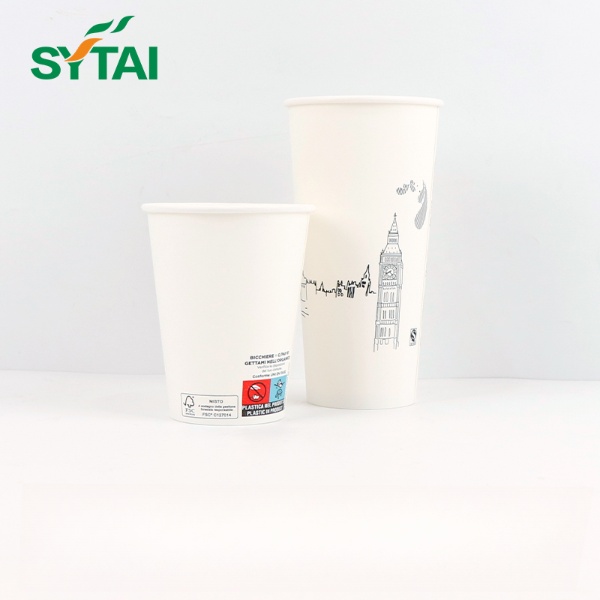
Taking the most common 16 oz size as an example: it typically features a 90 mm rim diameter, a 60 mm base diameter, and a height of approximately 135 mm, using paperboard with a basis weight of 260–320 gsm. A key advantage of this standardized sizing is the interchangeability of accessories—a single rim diameter can accommodate various lids, such as flat PP lids, domed lids, paper lids, or straw-slotted lids, allowing shops to stock a single type of lid regardless of cup capacity.
It is important to clarify a common misconception: "single-wall" does not necessarily mean "thin." The term refers to the number of structural layers, not the basis weight of the material. Among cups classified as "single-wall," those made with 260 gsm versus 320 gsm paperboard differ significantly in terms of rigidity, compressive strength, and tactile feel—with a corresponding price difference of 10%–20%. Consequently, asking only "what is the price per cup" without specifying the basis weight renders any price comparison meaningless.
Another point where buyers can be misled by sales rhetoric is the term "thickened" (or "extra-thick"). Many single-wall paper cups on the market are marketed simply as "thickened and leak-proof" without specifying the basis weight of the film coating. A more reliable, verifiable approach is to request specific data on the film coating weight and the sealing process, rather than relying on vague descriptive adjectives.
PE (Polyethylene) Coating – This is the most cost-effective solution with the most reliable leak-proof performance. Suitable for both hot and cold beverages, it currently accounts for the highest shipment volume. Its drawback is that it creates a paper-plastic composite, which requires separation during the recycling process; consequently, it is less advantageous in markets with strict mandates on packaging recyclability.
Water-based Coating – Offering leak-proof performance comparable to PE, this option results in a cup composed primarily of a single material (paper), making it well-suited for markets with specific regulations regarding recyclability. It is slightly less resistant to prolonged liquid exposure than PE; for cold beverages, a thicker-walled version—commonly referred to in the market as "16 oz paper cold cups"—is recommended.
PLA (Polylactic Acid) Coating – As a bio-based material, this is the most compelling choice for sustainability narratives centered on compostability. However, it has a lower heat tolerance than PE (it is generally not recommended for holding liquids above 90°C for extended periods). It is also sensitive to humidity during storage, so moisture-proof packaging is essential for long-duration ocean freight.
To put it plainly: choose PE if you are serving hot drinks and prioritizing cost; opt for thicker-walled PE or a water-based coating for cold drinks or high-humidity environments. Only adopt PLA if there is a specific requirement to promote compostability or recyclability—do not let a focus on "sustainability" concepts lead to product failures while on the shelf.
Single Wall Paper Cup: A Practical Guide to Sizes, Coatings and Wholesale Sourcing
2026-11-11
123123123
The overall cost and performance of a single-wall paper cup are determined by four key factors: the basis weight of the paperboard, the material used for the lining (coating), the rim-rolling technique, and the method of sealing the cup bottom.
Other specifications—such as capacity, diameter, and printing—are simply combinations built upon these four foundations. This article avoids unverifiable, vague terms like "eco-friendly" or "premium quality." Instead, it addresses three practical questions frequently encountered by procurement teams and store operators: what distinguishes single-wall cups from double-wall cups, which type of lining is appropriate for specific beverages, and how to effectively compare wholesale price quotes.
What Is a Single Wall Paper Cup?
A single-wall paper cup is constructed from a single sheet of food-grade paperboard, rolled to form the cup body. The interior is coated with a thin film to prevent leakage, and the top and bottom edges undergo specific forming processes. Lacking an insulating air gap or an outer corrugated layer, the cup wall consists of a simple two-layer structure: paper plus a film coating.
Taking the most common 16 oz size as an example: it typically features a 90 mm rim diameter, a 60 mm base diameter, and a height of approximately 135 mm, using paperboard with a basis weight of 260–320 gsm. A key advantage of this standardized sizing is the interchangeability of accessories—a single rim diameter can accommodate various lids, such as flat PP lids, domed lids, paper lids, or straw-slotted lids, allowing shops to stock a single type of lid regardless of cup capacity.
It is important to clarify a common misconception: "single-wall" does not necessarily mean "thin." The term refers to the number of structural layers, not the basis weight of the material. Among cups classified as "single-wall," those made with 260 gsm versus 320 gsm paperboard differ significantly in terms of rigidity, compressive strength, and tactile feel—with a corresponding price difference of 10%–20%. Consequently, asking only "what is the price per cup" without specifying the basis weight renders any price comparison meaningless.
Another point where buyers can be misled by sales rhetoric is the term "thickened" (or "extra-thick"). Many single-wall paper cups on the market are marketed simply as "thickened and leak-proof" without specifying the basis weight of the film coating. A more reliable, verifiable approach is to request specific data on the film coating weight and the sealing process, rather than relying on vague descriptive adjectives.
Single Wall vs Double Wall Paper Cup: Which One Fits Your Menu?
| Criteria | Single Wall | Double Wall | Ripple Wall |
|---|---|---|---|
| Structure | One sheet of food-grade paperboard + inner lining | Inner cup with an integrated outer sleeve | Inner cup with a corrugated outer wrap |
| Insulation | Basic — a cup sleeve is recommended | Good | Best |
| Cost per cup | Lowest | 20%–35% higher | Highest |
| Stacking ratio | Highest — maximum units per shipping container | Medium | Low |
| Print surface | Flat, high halftone reproduction | Flat, but the outer board is thicker | Corrugated texture, fine lines distort easily |
| Best for | Fast service, short holding time, dine-in | Hot drinks with a high takeaway share | Very hot drinks, long-distance delivery |
The logic is straightforward: if the time from the drink being prepared at the store to its consumption is 10 minutes or less, a single-walled cup paired with a paper sleeve offers the lowest total cost.
However, if more than half of the orders are for takeaway—with customers carrying their drinks while walking or cycling—a double-walled or corrugated cup is a more reliable choice. Most chain brands adopt a hybrid approach: they primarily use single-walled cups with sleeves, but switch to double-walled cups during peak periods in the autumn and winter, rather than relying on a single type year-round.
However, if more than half of the orders are for takeaway—with customers carrying their drinks while walking or cycling—a double-walled or corrugated cup is a more reliable choice. Most chain brands adopt a hybrid approach: they primarily use single-walled cups with sleeves, but switch to double-walled cups during peak periods in the autumn and winter, rather than relying on a single type year-round.
Paper Cup Sizes: What 8 oz, 12 oz, 16 oz and 20 oz Are Actually For
| Size | Capacity | Rim diameter | Typical use |
|---|---|---|---|
| 4 oz | Approx. 120 ml | 62 mm | Sampling, sauces, ice cream |
| 8 oz | Approx. 240 ml | 80 mm | Small americano, office pantries, kids' drinks |
| 12 oz | Approx. 355 ml | 90 mm | Medium milk tea, standard latte |
| 16 oz | Approx. 473 ml | 90 mm | Large hot drinks, cold brew, sparkling water |
| 20 oz | Approx. 590 ml | 90 mm | Large iced drinks, fruit tea, sharing size |
The 16 oz single-wall paper cup is currently the most frequently requested specification. It features a 90 mm rim diameter—the same as that used for 12 oz and 20 oz cups—allowing shops to use a single type of lid for both medium and large-sized drinks.
Demand for 8 oz paper cups typically comes from offices, hotel guest rooms, and sampling stations. These clients generally place smaller, more frequent orders, making them well-suited for purchasing standard, unprinted stock by the case.
Demand for 8 oz paper cups typically comes from offices, hotel guest rooms, and sampling stations. These clients generally place smaller, more frequent orders, making them well-suited for purchasing standard, unprinted stock by the case.
A practical rule of thumb: for iced beverages, assume the cup is filled to 80% capacity. A nominal 16 oz cup holds 473 ml; with ice, the actual liquid volume is only about 380–400 ml. If your recipe yields 450 ml per serving, you should opt for a 20 oz cup instead—otherwise, every drink will overflow.
PE, PLA or Water-Based Coating: Which Lining Fits Your Drink?
The coating is the most easily overlooked element, yet it has the greatest impact on customer complaints. Here is a breakdown of the three mainstream options:
PE (Polyethylene) Coating – This is the most cost-effective solution with the most reliable leak-proof performance. Suitable for both hot and cold beverages, it currently accounts for the highest shipment volume. Its drawback is that it creates a paper-plastic composite, which requires separation during the recycling process; consequently, it is less advantageous in markets with strict mandates on packaging recyclability.
Water-based Coating – Offering leak-proof performance comparable to PE, this option results in a cup composed primarily of a single material (paper), making it well-suited for markets with specific regulations regarding recyclability. It is slightly less resistant to prolonged liquid exposure than PE; for cold beverages, a thicker-walled version—commonly referred to in the market as "16 oz paper cold cups"—is recommended.
PLA (Polylactic Acid) Coating – As a bio-based material, this is the most compelling choice for sustainability narratives centered on compostability. However, it has a lower heat tolerance than PE (it is generally not recommended for holding liquids above 90°C for extended periods). It is also sensitive to humidity during storage, so moisture-proof packaging is essential for long-duration ocean freight.
To put it plainly: choose PE if you are serving hot drinks and prioritizing cost; opt for thicker-walled PE or a water-based coating for cold drinks or high-humidity environments. Only adopt PLA if there is a specific requirement to promote compostability or recyclability—do not let a focus on "sustainability" concepts lead to product failures while on the shelf.
FAQ
Can single-wall paper cups hold boiling water?
Yes, provided they feature a PE (polyethylene) lining and a paperboard basis weight of at least 280 gsm. For freshly boiled water, it is advisable to let it cool slightly or perform a quick, small-volume "pre-rinse" to prevent thermal fatigue at the cup’s seams.
Yes, provided they feature a PE (polyethylene) lining and a paperboard basis weight of at least 280 gsm. For freshly boiled water, it is advisable to let it cool slightly or perform a quick, small-volume "pre-rinse" to prevent thermal fatigue at the cup’s seams.
Are single-wall paper cups recyclable?
Recyclability depends on local infrastructure. Cups with water-based coatings or those designed as a single-material structure are more easily processed within paper recycling streams. If exporting, please verify the waste-sorting standards of the destination country.
Recyclability depends on local infrastructure. Cups with water-based coatings or those designed as a single-material structure are more easily processed within paper recycling streams. If exporting, please verify the waste-sorting standards of the destination country.
What kind of lid fits a 16 oz single-wall cup?
For a 90 mm rim diameter, you can use PP flat lids, dome lids, paper lids, or straw-slot lids. For cold drinks, a transparent flat lid with a straw is recommended; for hot drinks, use a dome lid or a leak-proof paper lid.
For a 90 mm rim diameter, you can use PP flat lids, dome lids, paper lids, or straw-slot lids. For cold drinks, a transparent flat lid with a straw is recommended; for hot drinks, use a dome lid or a leak-proof paper lid.
What is the minimum order quantity (MOQ) for custom printing?
Typically around 30,000 units, a figure largely determined by the costs of plate-making and machine setup. For small-scale trial runs, consider using stock (plain) cups paired with custom sleeves or stickers.
Typically around 30,000 units, a figure largely determined by the costs of plate-making and machine setup. For small-scale trial runs, consider using stock (plain) cups paired with custom sleeves or stickers.

Industry News - November 13, 2026
Paper Ice Cream Cups: Sizes, Lids & Wholesale B2B Guide
Leaking bases, cracked rims, popping lids: a spec-level guide to paper ice cream cups - sizes, coatings, carton cube, freight math and printing.
Industry News - November 09, 2026
Paper Noodle Box Guide: Sizes, Materials & Wholesale
Leak-proof or greaseproof? Compare paper noodle box sizes, linings and MOQ before you order, with folding steps and a fix list for common failures.
Industry News - October 27, 2026
Are Paper Plates Recyclable? The Honest Answer