Paper Soup Containers With Lids: A Catering Buyer's Guide to Fewer Leaks and Lower Cost per Serving
 123123123
Paper Soup Containers With Lids: A Catering Buyer's Guide to Fewer Leaks and Lower Cost per Serving
Paper Soup Containers With Lids: Three Numbers to Compare Before Price
| Number to check | What it controls | What goes wrong when it is off |
|---|---|---|
| Rim (top) diameter | Lid fit, carrier fit, whether your existing lids and cup holders still work | A 1–2 mm difference makes every lid in your stock unusable; carriers grip loosely and cups tip in transit |
| Fillable capacity vs nominal capacity | Portion cost, headspace, whether the soup reaches the lid | Filling to the nominal figure leaves no headspace; soup touches the lid, wicks, and the seam stains before delivery |
| Carton cube and pieces per carton | Freight per piece, warehouse space, reorder frequency | A bulky carton can add 15–20% to landed cost per piece even at identical FOB price |
Liner Choice Is a Market Decision, Not a Green Badge
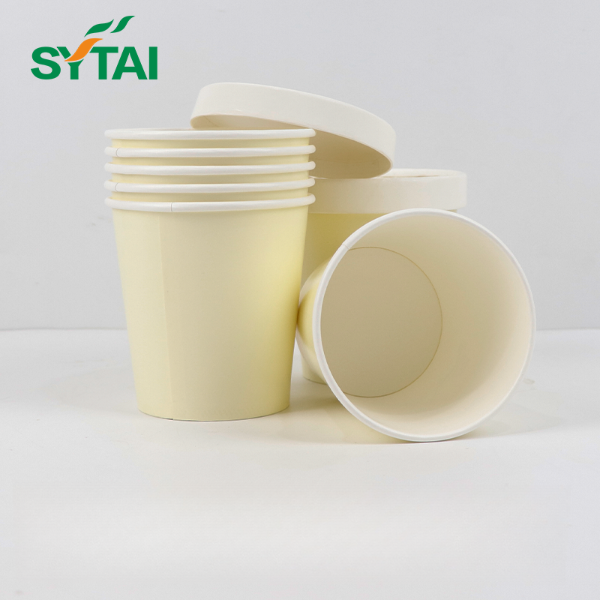
The same cup body can carry PE, PLA or Bio-PBS lining, and the three are not interchangeable upgrades. They are answers to three different market questions.
PE remains the default for hot, oily and acidic soups because it is dimensionally stable and the cheapest per unit. PLA is the plant-based route for markets with industrial composting infrastructure and buyers who need an EN 13432 pathway — note that compostability certification applies to a specific finished article, so ask whether the certificate covers the cup, the lid, or both. Bio-PBS suits buyers targeting biodegradability claims in markets such as Japan and parts of Asia-Pacific, where the applicable standard is not the European one.
Then there is the part catalogues skip: liner performance is soup-specific. A lining that handles cream of mushroom may struggle with tomato, vinegar-based broths or alcohol-containing desserts, because acidity and fat attack the film differently. Before a season starts, run the actual product through the actual container for the actual holding time. A sample test costs a week; a recall costs a season.
Documentation to request with any bulk order, regardless of liner: a declaration of food-contact compliance for the finished article, migration test reports for the specific liner, and the scope statement for any compostability certificate. Increasingly, packaging fees in Europe are modulated by material and recyclability, so the liner decision also shows up in your EPR reporting — which means it belongs in a procurement meeting, not only in a sustainability deck.
FAQ
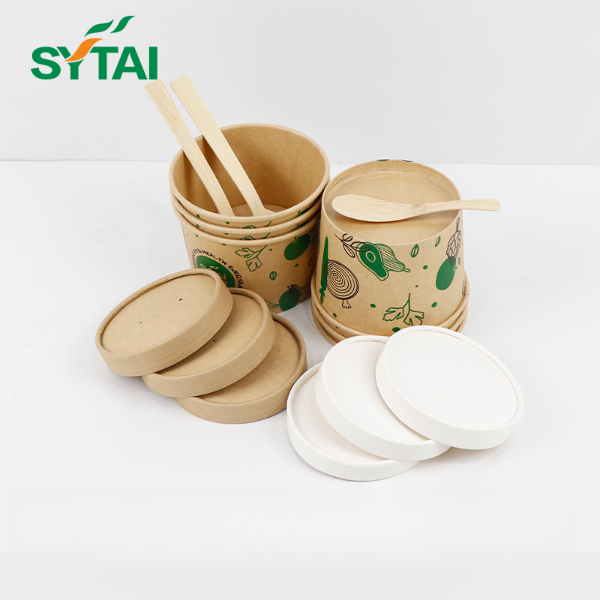
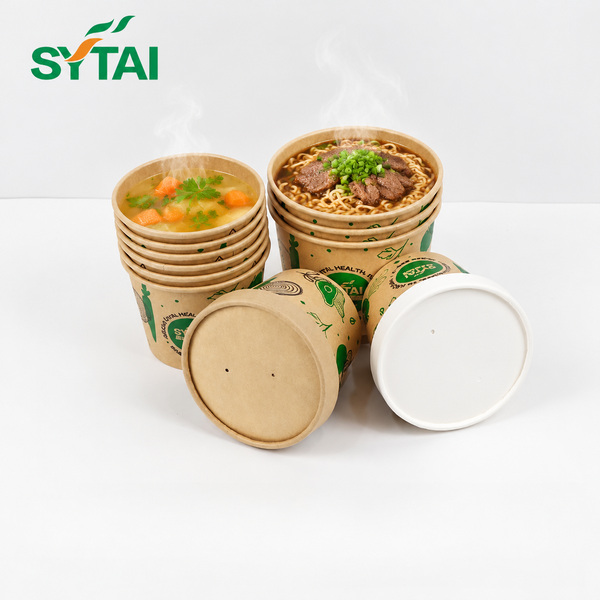
By arithmetic, 26 US fluid ounces is about 780 ml. What you can safely fill is less, because hot soup needs headspace and because the rim area belongs to the lid, not the portion. Ask for the recommended fill line and match it to your ladle size — that number, not the nominal capacity, determines your actual cost per serving.
Standard PE-lined cups are designed for hot filling and short holding, not for repeated reheating. If your service model includes customer reheating, say so before ordering: the liner, the lid and the venting all need to be specified for it, and the answer must come from the factory rather than from a general claim on a website.
Only if the rim diameter and the rim profile match, and the profile is the part nobody publishes. Two 115 mm cups from different factories can still refuse each other's lids because the rolled edge is shaped differently. Test with production samples, not with a single hand sample, and check the fit after the cup has held hot liquid for twenty minutes.